
Process as the Piece
Subheading's under construction

Howdy~

Last month was an experiment.
For those who didn’t have an hour to pore over that post (who could blame you really), February’s entry was my attempt at a bloggified demos album: housing in one place a bunch of shaggy first draft songs that were otherwise gathering digital dust on my laptop. Voice memos, videos, sketches, scratch tracks… aka a bunch of stuff I’ll never get around to producing “properly.”
Posting that led me to a few questions. Why do we indulge peeks behind-the-scenes? Why might that matter? What happens when process is the concern, the pretense, the presentation of a thing?
What happens when process is the piece itself?

I don’t think I can speak primarily about film, television, or the novel here. The filmmaker, the show-runner and the novelist all dramatize real-world processes into plot. Rising action, climax, falling action? That’s essentially just characters piecing some sort of puzzle together, when you really get down to it.
To reframe, storytelling is usually process made manifest, made narrative. And it’s incredibly life-affirming to watch; this is why medical procedurals, making-of documentaries, and high stakes dramas, especially, are all so popular. People love watching problems be solvable. All it takes is a little bit of processing power and some elbow grease.
Music is a little less transparent from this angle. Music tends to abstract its storytelling. The main “conflict” of a song is harmonic tension that you feel rather than intellectualize. The “conflict resolution” in song is the release of said tension.
In other words, music is vibes-based. Atmospheric. Unless you’re talking about a true story-song or ballad, process is just not (typically) made explicit or narrative in music. But there some exceptions that I’ve come across.
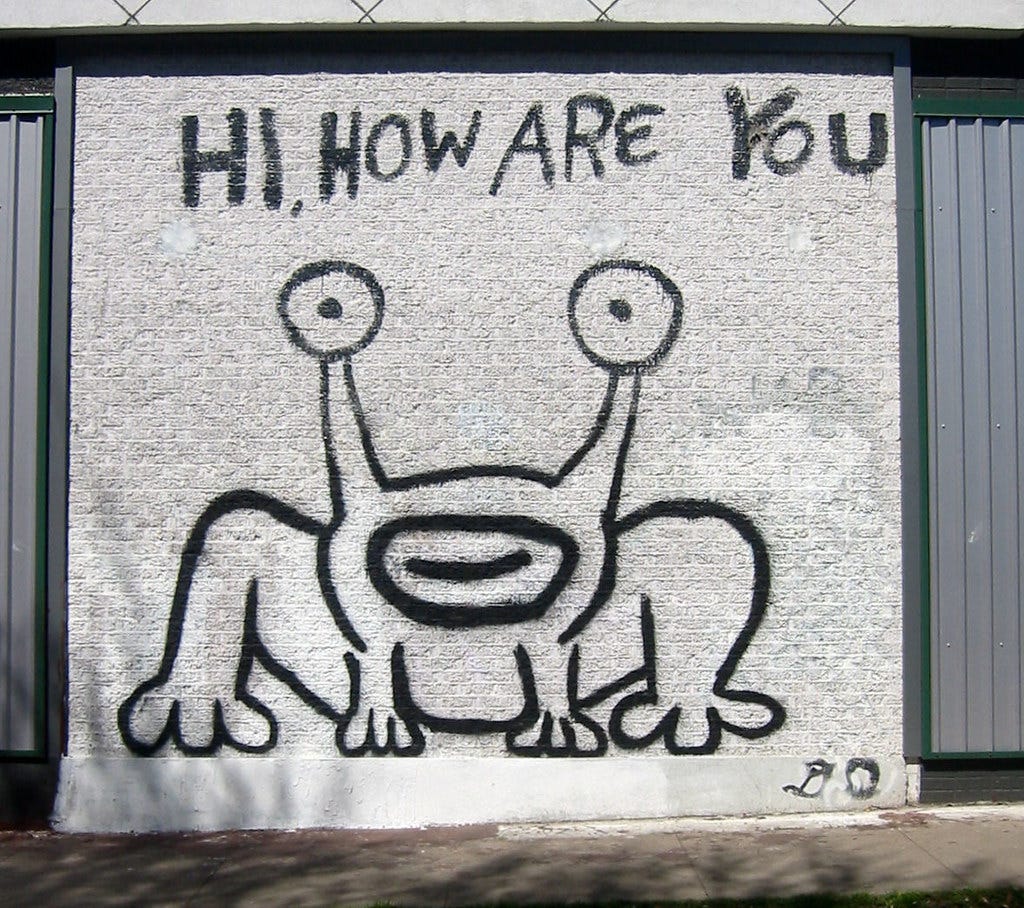
Daniel Johnston, best example. I was living in Austin when he died—his HQ for years. In 2019, I had no idea who this guy was. But the big thing that I eventually learned about him was his career was launched and sustained by documenting the earliest stages of creative process. Go with me on some bullet points here:
He mysteriously appears in Austin one day in the eighties, gets a job bussing tables at a McDonald’s, and starts a grassroots campaign handing out homemade releases of his enormous songwriting catalog. Each tape is a unique, one-of-a-kind performance, created just for that particular cassette. People really respond to the TLC. Somewhere along the line Kurt Cobain is spotted wearing a tee of the Hi, How Are You album art, and the rest is history. Daniel Johnston swiftly becomes an Austin legend, and a bastion of the outsider art movement.
His meteoric rise is inextricable from the music itself, but I do think that DJ’s music can stand on its own. The songs are plenty and the songs are sturdy. Consider the covers from Wayne Coyne, Phoebe Bridgers, Jeff Tweedy, Eddie Vedder, et cetera. Myriad artists can vocalize just how resilient a Johnston melody and lyric can be, so I don’t think his merit as a songwriter was ever really in question.
The question that delights me more is why these revered artists responded to the lo-fi, shaggy, out-of-tune nature of his work in the first place? How did those qualities build Daniel Johnston into an icon? What was really going on there?
Well, just look to Jeremiah the Frog, his most famous creation.
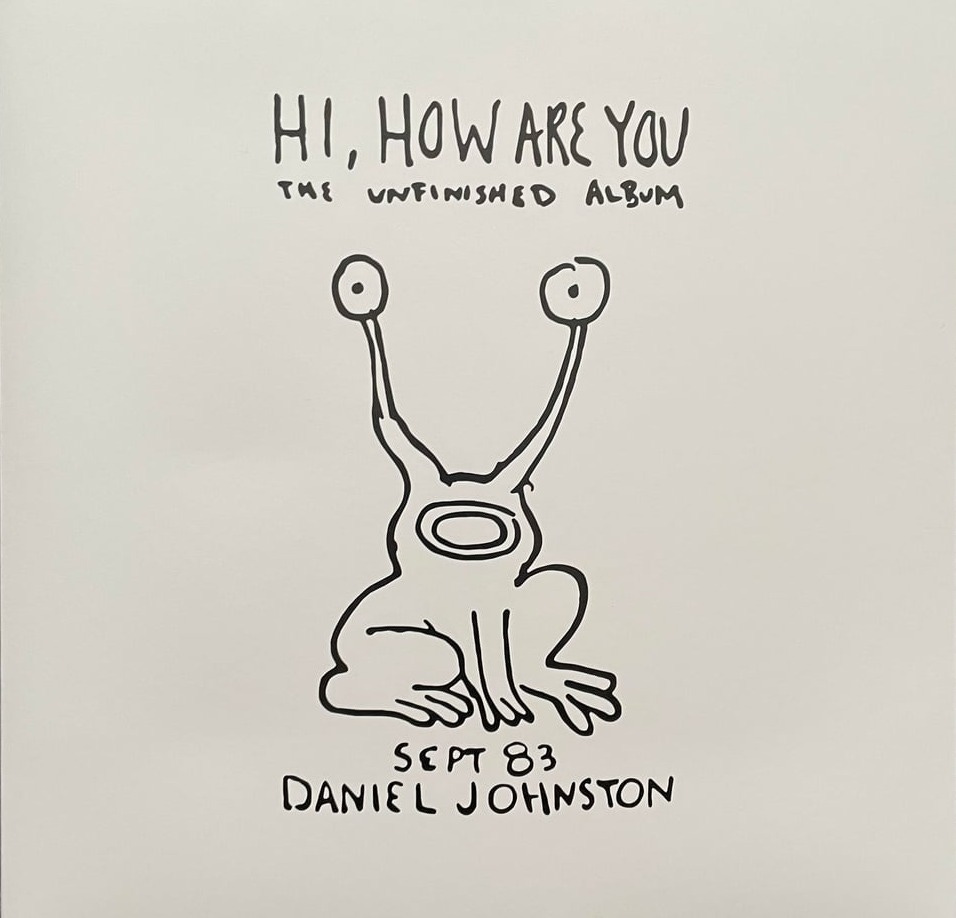
Centered right above Jeremiah’s eyestalks, on the album cover of Hi, How Are You, is the subtitle “The Unfinished Album.” It was no mistake that Johnston labelled HHAY tapes this way, and that that made its way onto Kurt Cobain’s fateful tee shirt. He wanted folks to know that he was in the middle of a process, a state of incompletion. This was integral to your first impression of him. There was something so disarming about that.
A great deal of DJ’s music was stylized as incomplete. You could see it in the sketchiness of the hand-drawn album art, you could hear it in the way the chords formed under his hands, and you could feel him searching for the notes when he sang. But it left an impact! Hell, I remember exactly where I was the first time I heard a Daniel Johnston song, because it was so flooring to experience something that innocent and intentional at the same time.
This was during a commute home in North Austin. KUTX spun the song “Speeding Motorcycle” with no preamble or post-mortem. It was just quietly included within a playlist of otherwise-produced college radio fare. As it played through, I swore you could actually hear Johnston’s fingers fighting with the organ keys. He hooted and hollered during a coda he hadn’t quite figured out. It was all very childlike, but somehow not childish. I had to pull over just to figure out what the hell that was.
All of this is to say that process exposed in music is rare, but when done right—there’s really nothing quite like it. I had a true, honest-to-God experience in hearing that song. It literally stopped me in my tracks.
I’m still thinking about it, seven years later.
~~~~~~~~~~~~~~~~~~~~~~~~~~~~~~~~~~~~~~~~~~~~~~~~~~~~~~~~~~~~~~~~~~~~~~~~~~~~
Barebones process as music is rare, sure, but of course there are other examples. One Wayne G (2023) from Mac DeMarco comes to mind, that 199 track-long freakshow. But Mac just explains that away; process-dumping was just his method of cleaning the slate and starting fresh.
Over the course of about eight hours and however many disks, One Wayne G stood to house years of unfinished work and instrumental experiments. After it dropped, Mac took several interviews and promoted the hell out of One Wayne G as a strategy, all while challenging what a mainstream discography can even look like. You could tell he was really cared about the importance of process, and he wanted you to know about it.
Legacy artists also highlight demos, outtakes, and alternate versions, typically tacked onto album anniversary releases. Cash grab or no, I still think bonus tracks are really the only way to humanize legends like the Beatles. It’s also one of the few facets of that band that (arguably) hasn’t been done to death. Hearing something like the Esher demos helps you to realize that making things is completely attainable. These are not mythical figures channeling the high above; they were four guys being dudes, just trying to squash their boredom.
~~~~~~~~~~~~~~~~~~~~~~~~~~~~~~~~~~~~~~~~~~~~~~~~~~~~~~~~~~~~~~~~~~~~~~~~~~~~
This is why encountering process in our art and culture is important. It’s not only an invitation to a little more intimacy with our favorite artists; it’s a stark reminder that creativity is not divine intervention. It’s letting your mind wander, iterating, and finding a solution to whatever the current conundrum may be. Seeing process demonstrated in our entertainment is a way for us to demystify our creative heroes, and also to safely simulate problems ourselves.
The current climate will not soon let us forget that we are totally surrounded by failing systems and failing processes. Creative process, thankfully, is not among those ranks. In fact, it is quite to the contrary—our greatest strength as a people is that we can think through a challenge. Art and music is just a trippy reflection of that, one that somehow still allows for us to see ourselves clearer.
The upshot is: process itself has an inherent value. Keep an eye out for it. Look for the brushstrokes, and appreciate it whenever you can. What is it they say? That the journey is the destination and all that?
Something like that. I’ll figure it out.
~~~~~~~~~~~~~~~~~~~~~~~~~~~~~~~~~~~~~~~~~~~~~~~~~~~~~~~~~~~~~~~~~~~~~~~~~~~~
for other fun examples of process in media check out:
the constructivist movement in architecture
the fluxus movement in mid-century art
Mad Men (all-time favorite tv show. Yes, it’s mainly about a traumatized philanderer, but the ad pitches and accompanying couch naps are SO good in terms of depicting process)
Midst (time-lapsed screen-captures of world class poets writing their poetry)
Thanks for readin
- sjg / dizzy / etc